
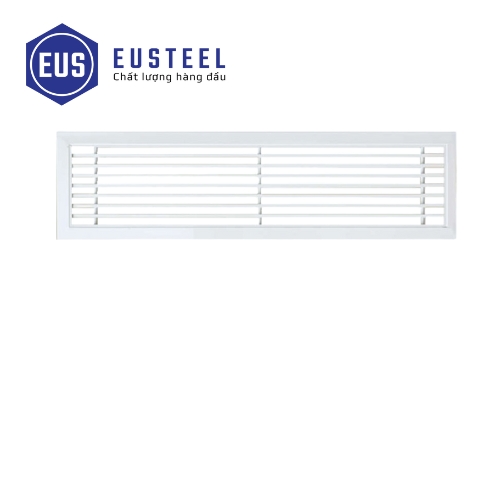
What is a T-Bar Air Grille? – Classification and Applications in HVAC Systems
1. What is a T-Bar Air Grille?
A T-bar air grille (also known as a linear grille or T-bar diffuser) is a type of air outlet designed with T-shaped blades arranged in parallel, forming long and uniform air slots.
It is an important component in HVAC (Heating, Ventilation, and Air Conditioning) systems, used to efficiently distribute and return air.
This type of grille is commonly installed on gypsum ceilings, walls, or directly on ductwork.
Thanks to its linear slot design, it offers:
- Even and stable airflow distribution
- High aesthetic appeal (especially in modern buildings)
- The ability to conceal the interior of duct systems
2. Structure of a T-Bar Air Grille
A standard T-bar grille typically includes:
- Frame: Extruded aluminum (commonly ~0.75 mm thick)
- Blades: T-shaped (~0.6 mm thick)
- Reinforcement bars: Increase structural strength
- Coating: Powder coating for corrosion resistance
- Optional accessories:
- Volume control damper (OBD)
- Air filter
The most common material is aluminum A6063-T5 due to its lightweight, durability, and corrosion resistance.
3. Common Classifications of T-Bar Air Grilles
3.1 By Function
- Supply T-bar grille
- Delivers cooled or fresh air into the space
- Linear slots ensure even air distribution
- Commonly used in offices and hotels
- Return T-bar grille
- Returns air to AHU/FCU systems
- Can be combined with filters
- Helps maintain air circulation
3.2 By Structure
- Fixed blade type
- Blades are non-adjustable
- Durable and cost-effective
- Commonly used for return air
- Removable core type
- Core can be removed for cleaning and maintenance
- Easy access to duct interior
- More flexible in operation
3.3 By Design (Number of Slots)
- Single-slot (1 slot)
- One air slot
- Suitable for small spaces
- Multi-slot (2–4 slots)
- Higher airflow capacity
- Suitable for large areas such as lobbies and halls
3.4 By Material
- Powder-coated aluminum (most common)
- Galvanized steel (lower cost, industrial use)
- ABS plastic (lightweight, corrosion-resistant, residential use)
4. Advantages of T-Bar Air Grilles
- Even air distribution, reducing direct airflow
- Modern design suitable for ceiling applications
- Conceals ductwork behind the grille
- Durable with low maintenance requirements
- Flexible installation (ceiling, wall, or plenum box)
Notably, this type of grille has a high effective free area (~79%), helping optimize HVAC system performance.
5. Applications
T-bar air grilles are widely used in:
- Office buildings
- Shopping centers
- Hotels and resorts
- Restaurants and showrooms
- Factories and production facilities
They are especially suitable for spaces requiring high aesthetics and linear airflow distribution.
6. Selection Tips
When choosing a T-bar air grille, consider:
- Length and number of slots based on airflow requirements
- Whether a volume control damper (OBD) is needed
- Fixed or removable type depending on maintenance needs
- Material suitability for the environment (humidity, dust, industrial conditions)
- Color compatibility with interior design
7. Conclusion
T-bar air grilles are an optimal solution for modern buildings due to their linear airflow distribution, aesthetic design, and installation flexibility. Understanding their classifications helps in selecting the right product and improving overall HVAC system performance.