
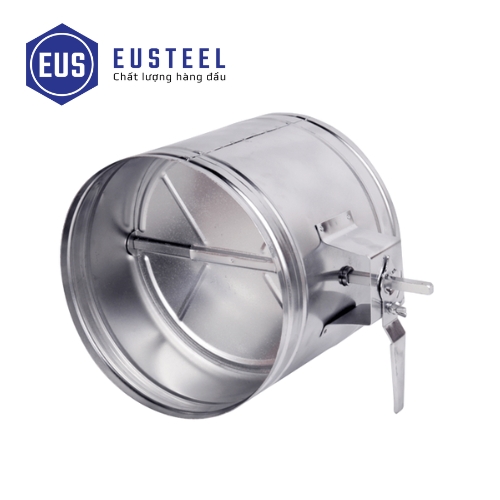
OPERATING PRINCIPLE OF A MANUAL AIR DAMPER
1. Overview of the Operating Principle
A manual air damper operates by adjusting the angle of its blades to control the airflow passing through it.
When the position of the handle (lever) is changed, the blades rotate accordingly, thereby altering the cross-sectional area of the airflow.
2. Detailed Operating Principle
2.1 Fully Open Position
- The handle is in the open position
- The blades are parallel to the airflow
- Airflow reaches its maximum
- Pressure loss is minimal
2.2 Partially Open Position
- The blades are angled
- The airflow cross-sectional area is reduced
- Airflow decreases accordingly
- Pressure loss occurs
2.3 Fully Closed Position
- The blades are perpendicular to the airflow
- The airflow is almost completely blocked
- There may still be slight leakage depending on the sealing quality
3. Factors Affecting Performance
3.1 Blade Angle
- The smaller the angle, the lower the airflow
- Precise adjustment is required for optimal performance
3.2 Airtightness
- Good sealing (gasket) helps minimize leakage
- Directly affects system efficiency
3.3 Material Quality
- A sturdy structure ensures stable operation
- Reduces vibration and noise
4. Advantages of the Manual Mechanism
✔ Quick and easy adjustment
✔ No power supply required
✔ Low failure rate
✔ Suitable for simple systems
5. Disadvantages to Consider
- No automatic control
- Less precise than motorized dampers
- Requires manual operation
6. Applications Based on the Principle
Thanks to its simple mechanism, manual air dampers are commonly used in:
- Basic ventilation systems
- Factories and workshops
- Projects that do not require high automation
7. Conclusion
The operating principle of a manual air damper is based on changing the blade angle to regulate airflow. Although simple, when used properly, it can still deliver stable performance and cost efficiency.