
What Is a Y-Branch Duct Fitting? Advantages & How to Choose Effectively
1. What is a Y-branch duct fitting?
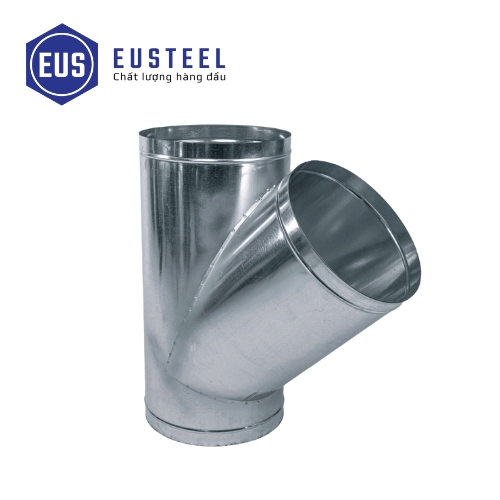
A Y-branch duct fitting (Y-branch duct fitting) is a component used to split or combine airflow in ventilation systems.
Its Y-shaped design allows smoother airflow separation compared to a T-branch, helping reduce pressure loss.
2. Structure of a Y-branch
A Y-branch consists of:
- Main duct
- Branch duct
- Branch angle (typically 30°–60°)
- Flange connection or slip joint
Its aerodynamic design helps minimize airflow turbulence.
3. Key advantages of a Y-branch
✔ Lower pressure loss compared to T-branch
✔ Improved air distribution efficiency
✔ Reduced system noise
✔ More stable airflow
4. Types of Y-branch fittings
🔹 By shape
- Round Y-branch
- Square Y-branch
🔹 By angle
- 30° (lowest pressure loss)
- 45° (most common)
- 60°
🔹 By material
- Galvanized steel
- Stainless steel
- Painted steel
5. Applications
Y-branch fittings are widely used in:
- Building HVAC systems
- Manufacturing plants
- Industrial dust extraction systems
- Basement ventilation systems
- Shopping malls
6. Comparison: Y-branch vs T-branch
| Criteria | Y-branch | T-branch |
|---|---|---|
| Pressure loss | Low | High |
| Noise level | Low | High |
| Efficiency | High | Medium |
| Cost | Higher | Lower |
👉 If efficiency is the priority → choose a Y-branch.
7. Notes when selecting a Y-branch
- Choose an appropriate branch angle (preferably 30°–45°)
- Ensure size compatibility with the duct system
- Check air tightness and joint quality
- Select materials suitable for the working environment
8. Conclusion
A Y-branch duct fitting is an optimal solution for airflow distribution in duct systems, improving operational efficiency and reducing energy consumption. It is an ideal choice for modern construction projects.